cardmaking · Mixed Media · Tutorial

3 Mixed Media Layers to Try (Beyond the Basics Techniques That Actually Work)

Simple layering techniques to add depth, texture, and interest to your mixed media cards—without the overwhelm.

Mixed media card with layered watercolor background, texture paste, stamping, embossing and vintage suitcase focal point

If you love mixed media but feel like your projects need a little more depth, this post is for you.

In today’s tutorial, I’m sharing three easy mixed media layering techniques that go beyond the basics—simple additions that create texture, interest, and that “something extra” that makes a card feel finished.

These layers are beginner-friendly, easy to repeat, and surprisingly impactful.

This post is part of my ongoing mixed media series where I create a card or tag using my easy to follow recipe.

After years of experimenting (and plenty of trial and error), I developed a simple 3-step recipe that works on almost every project.

And today, I’m sharing it with you.


✂️ In This Post, You’ll Learn:

• My 3-Step Mixed Media Recipe
• How to create an easy watercolor background
• How to layer like a pro
• How to create an interesting focal point


Karen’s 3-Step Mixed Media Recipe

Step 1: Create an Interesting Background
Step 2: Add 4+ Layers
Step 3: Add a Strong Focal Point

Simple. Repeatable. And it works on almost every project.

📌 Save this for later so you can come back when you’re ready to try this technique.


8 mixed media cards and tags from my continuing series: Mixed Media Made Simple.

If you’re new to this series, start here:
👉 Mixed Media Made Simple: My 3-Step Recipe for Fun & Easy Tags

And if you missed my foundational layering post, you’ll definitely want to read this first:
👉 Mixed Media Layering Made Simple: The 4 Layers I Use on Almost Every Project

Because today…

We’re Building On That Foundation

This post is your next step.

We’re taking the “Fab 4” layers and adding three more techniques to create a richer, more dimensional, slightly more advanced mixed media look—without losing that relaxed, beginner-friendly feel.

And the best part?

We’re using a very similar design (same colors, same focal point, same vibe) so you can clearly see how your work can evolve.

If you try this technique, tag your project with:
👉 #karensmixedmediarecipe — I would truly love to see what you create!

If you are interested in adding a new supply or two to your toolbox, you can check out my Favorite Supplies page.

Vintage look mixed media card with watercolor background that features Spellbinders Retro Suitcase die SDS-221

Step 1: Create a Background

Let’s keep this part simple and approachable.

For this card, I created:

  • A two-color watercolor background using a loose, abstract “Y” shape in soft blue
  • Filled the remaining space with warm yellow
  • A second yellow wash panel for the suitcase focal point
  • A third panel using direct-to-paper brown ink + water for a leather-like texture

💡 Tip: Don’t overthink placement—this is about movement, not perfection.

creating watercolor panels is the best first step for creating mixed medai card backgrounds and components.
Here are the 3 watercolors panels we will be using on today’s mixed media card.

Step 2: Layering — The Fab 4 + 3 More

We’re starting with the Fab 4 (your go-to layers), then building upward.

Think of this as:
👉 easy, relaxed complexity


The Fab 4 (Your Foundation Layers)

1. Stenciling (Pattern)

Add soft script in 1–2 areas using brown ink.

✔ Adds structure
✔ Keeps things grounded
✔ Works on every project

brown ink + script stencil is the best first layer for mixed media projects.
Adding soft script stenciling creates subtle pattern and movement

2. Stamping (Personality + Vintage Charm)

Use second-generation stamping (stamp once on scrap, then your panel).

I used:

  • Blue + brown inks
  • Imperfect shapes, lines, and marks

✔ Keeps everything cohesive
✔ Adds that “collected over time” look

second generation stamping with brown ink gives vintage vibe to mixed media card projects.
Second-generation stamping softens the look and blends beautifully

Now Let’s Level Up…

Here are the 3 additional layers that take your project from beginner to beautifully complex:


3. Texture Paste (3D Dimension)

Using a cobblestone stencil, I applied:

  • Blue-tinted paste
  • Brown-tinted paste
Applying tinted texture paste to mixed media  backgrounds eleveates cards from beginner level to intermediate.
Texture paste adds loads of dimension to cardmaking projects.

The result? A soft, two-tone textured layer.

✔ Adds tactile interest
✔ Creates visual depth
✔ Feels artistic and elevated

I tinted texture paste and applied with a stencil on layer 3 and you can see other layering options on my Go-To Cardmaking Supplies page.


4. Heat Embossing (Controlled Drama)

I partially stamped a Bubble Celebration background stamp using pigment ink, then heat embossed.

✔ Adds texture and contrast
✔ Keeps things imperfect and organic
✔ Creates a subtle focal texture

Partial heat embossing bubble circles on a mixed media card background adds texture and interest.
Imperfect embossing adds texture without overpowering the design.

5. Distress Crayons (Soft Aging Effect)

Add scribbles… then activate with water.

✔ Blends into previous layers
✔ Adds softness and movement
✔ Creates that “aged over time” feel

Distress crayons can add interest to mixed media card backgrounds.
A few scribbles before brushing with a wet brush.

Finish the Fab 4

6. Distress the Edges

Frame your design with brown ink.

✔ Instantly adds depth
✔ Gives a vintage finish

Intermediate level mixed media cardbackground with 6 layers, including distressing the edges with brown ink.
Distressing the edges really adds to the vintage charm of mixed media projects.

7. Splatters (Movement + Cohesion)

  • Water splatters (blotted)
  • Blue + brown splatters

✔ Pull everything together
✔ Add energy and life

Adding splatters to mixed media intermediate level watercolor card background that has 7 different layering techniques.
Don’t skip adding splatters, they really unify your projects.

How Do You Know When to Stop?

  • Let it sit for an hour (or overnight)
  • Take a photo
  • Ask: Does this feel balanced—or busy?

Today’s card: 7 layers total


✨ Why These Layers Work

  • Easy to repeat
  • Build depth without clutter
  • Work with supplies you already have
  • Add a polished, finished look

Step 3: Add a Strong Focal Point

Mixed media needs a visual anchor.

Today, I used the Retro Suitcase Die—one of my favorites.

But here’s where we elevate it:

✨ I used a BetterPress map background on the suitcase panel
✨ Lightly distressed the edges
✨ Assembled using layered die cuts

Step-by-step mixed media layering process showing stencil, stamping, and texture paste techniques for cardmakers + die cut focal point.
Vintage look die cut focal points really add to the retro beauty of mixed media background panels.

Then added:

  • Ephemera tickets (tucked behind)
  • A sentiment strip: “Friends and laughter help lighten the load”

✔ Storytelling
✔ Depth
✔ Vintage travel charm


Let’s Talk Color (Why This Works)

We kept it simple:

  • Soft blue
  • Warm yellow
  • Neutral brown

✔ Blue = calm
✔ Yellow = energy
✔ Brown = grounding

And together?

👉 A cohesive, vintage-inspired palette that feels intentional—not chaotic.


Beginner vs. Intermediate — Side-by-Side

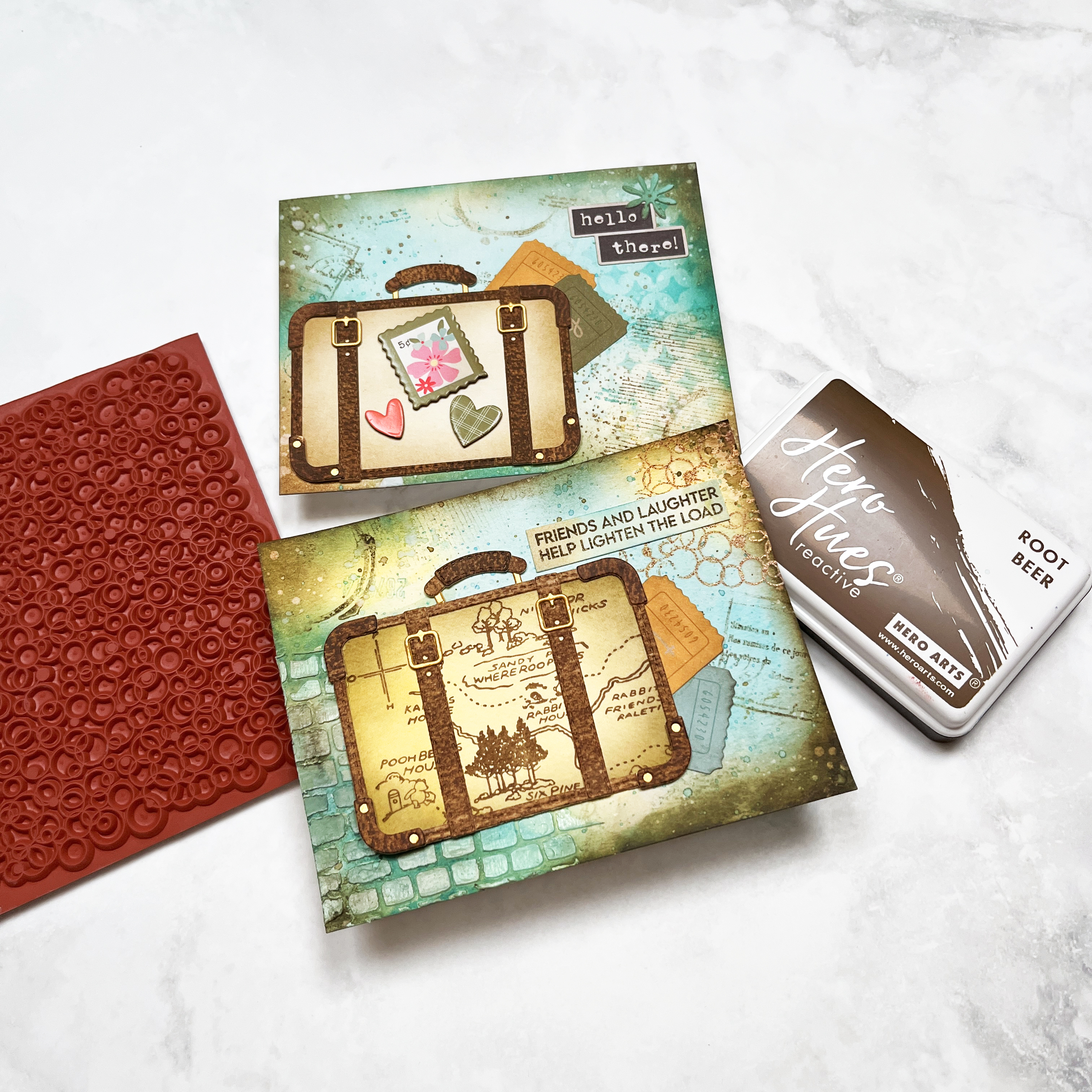
Beginner to intermediate mixed media card comparison with blue, yellow and brown color palette and vintage travel theme.

This is where the magic happens.

Fab 4 Card (Top Card) from The 4-Layers I Use on Everything post

  • Brighter
  • Simpler
  • Clean layering

Fab 4 + 3 Card (Bottom Card):

  • More texture
  • Slightly moodier
  • Richer detail

👉 Same foundation… just built up.


Other Posts in This Series


Craft Toolbox

These are the core tools I use when building layered mixed media backgrounds

You might also be interested in my 14 Best Cardmaking Supplies for 2026 post.

Focal Point:
Retro Suitcase Die + BetterPress Map

Inks:

Tools & Layers:

Basics:

Final Thoughts

This is where mixed media really starts to feel magical.

Not because it’s complicated…
But because you’re learning how to layer with intention.

Start with the Fab 4.
Add one or two new techniques.
And let your style evolve naturally.

📌 Save this for later so you can come back when you’re ready to try this recipe.

💬 Which layer was your favorite? I’d love to hear in the comments!

🏆 Proud to be ranked among the Top Cardmaking Blogs by Feedspot


cardmaking · papercrafting

Cardmaking with Glitter Cardstock

Cardmaking with Altenew Glitter Cardstock in Pink Brilliance + Cosmos Layering Dies.

Glitter and shine….sometimes it is fun to add a little sparkle to a card! Today I used some Glitter Cardstock to make an ultra girly card. I used glitter cardstock as the bottom layer on my blooms, flower centers and sentiment. I created this card to be part of Altenew’s Educator Instagram Hop and we’d love for you to “hop” along with us. You can start at @altenewllc and my IG hande is: karens_mini. Hope to see you!

Cardmaking with Altenew Glitter Cardstock in Pink Brilliance + Cosmos Layering Dies.

My Process:

Cardmaking with Altenew Glitter Cardstock in Pink Brilliance + Cosmos Layering Dies.

I think the end result is a happy cheerful birthday card that I can’t wait to give my friend. Thank you for stopping by!

Karen

Uncategorized

Altenew Certified Educators Instagram Blog Hop

Layered Floral Die-Cutting with Altenew’s Cosmos Kit

 I am so excited to be participating in my first Altenew Educator Hop!  I LOVE this month\’s Cosmos Craft-A-Flower Kit and wanted to create another bright springy card.  Here is a LINK to my first card.  

Die-cut watercolored pink flowers

Mixed Media Background

I made a background using the recently released Narrow Brick Stencil.  I mixed Texture Embossing Paste and Shimmer Spray which I then tinted with diluted purple Watercolor from the 36 pan set.  I repeated this and added diluted pink watercolor to a second pile of embossing paste.  I then ran this over the stencil in random locations.  The two colors of brick are the same colors I used on the flowers.  

Altenew Cosmos kit

Water Coloring Panels for Die-Cutting

On two panels of watercolor paper,  I brushed on bold watercolors from the 36 pan set.  I dried the panels and added a second layer so I had really saturated color.  Here is a photo of the three panels I used to make this card.

Before I begin die-cutting I like to take a permanent pen and mark the layering dies with a #1 and #2 for each flower.  It just takes just a minute but then it is so much easier to keep up with the little pieces. After I die cut, I also write the corresponding number on the back of the die-cut in pencil in case they get mixed up on my workspace.  

Pink die-cut flowers with mixed media background

These flowers are so easy to assemble and make such a gorgeous showy flower.  I used liquid glue and foam tape to assemble my card.  To finish, I added Tea Party Enamel Dots.


We would love for you to hop with us!  My Instagram Handle is: @karens_mini 

There are beautiful cards and prizes too….check it out!

Thanks so much for stopping by!
Karen
Uncategorized

Altenew Academy – Seasonal Scene Building

Hello and welcome.  I just finished Nichol Spohr\’s Altenew class on scene building and wanted to share this card.  I love \”scene cards\” so this class was very fun for me.  My card concept was \”coffee in the garden\”.  I was especially inspired by Nicole\’s lessons #1 and #4 on creating scenes and die-cut scenes.  
A scene card featuring Altenew Gardent Grow and Tea Time stamp and die bundles with Watercolor Stripes stencil and texture paste to create the background.
My Process:
Once I came up with my coffee in the garden theme, I started by working on my background.  I wanted to use a stencil technique that I learned in Laurel Beard\’s Stencil Techniques class.  I had never worked with embossing/texture paste and I found I really liked it.  I knew I wanted a subtle plank like background so I made three….a neutral tan, soft blue and light yellow.  I tinted the paste with dye ink and used a palette knife to work it through my stencil. I left the finish a bit rough and rustic and then put the panels aside to dry.  I really like the texture and look of the background.  

Next I stamped, Copic colored and die cut my images.  By this time my backgrounds were dry so I laid the die-cuts on each and decided I liked the neutral tan the best.  I adhered the images with foam tape and popped on a card base.
Supplies Used:
Altenew Garden Grow stamp and die bundle
Altenew Tea Time stamp and die bundle
Altenew Watercolor Stripes Background stencil
Altenew Sand Dunes Crisp die ink (to tint the paste)
Texture paste and pallet knife
Copic markers
Foam tape

I am also joining:
As You Like It Scene Challenge  I enjoy a latte in my garden every afternoon and depicted this scene on my card.  

Time Out Proust Quote Challenge   This is a wonderful quote that speaks to me.  I focused on the gardening aspect of the quote for my card.  

Update:
I was so pleased to learn that my card was selected as a top three at Time Out Challenges. 

I think this is a fun scene card that would work for a man or woman.  Thank your for stopping by!
Karen